How to Make a Gritty Phonk Beat: The Plugin Chains That Actually Matter
Disclosure: some links below are affiliate links. If you buy through them, the blog earns a small cut — at no extra cost to you. The picks are the same ones I'd reach for either way.
Let's kill the myth first. Phonk doesn't sound expensive. It's not supposed to. The whole point is dirt — saturation, hiss, an 808 that sounds like it's about to tear the cone off your monitor. If your drift phonk loop sounds clean, you've already lost the plot.
But "dirty" isn't the same as "lazy." There's a difference between a track that sounds raw and one that just sounds bad. That difference is the chain. Below is the workflow — what each move does, why it does it, and the tools that get you there fast.
What "gritty" actually means
Three things carry the sound. Get these right and the rest is decoration.
- The cowbell. The signature. It needs to cut, not stab. Pitch it, season it with saturation, sit it just under pain threshold.
- The distorted 808. The backbone. Not "loud" — controlled loud. Harmonics are what make a sub audible on a phone speaker, and harmonics come from distortion, not from the volume fader.
- Lo-fi degradation. The glue. Hiss, wobble, a touch of bitcrush. This is what tricks the ear into hearing "sampled off an old tape" instead of "made in a browser tab last Tuesday."
That's it. Everything else is taste.
The 808 chain (the part everyone gets wrong)
Most beginners crank the gain and wonder why it turns to mush. Order matters more than amount. Build it like this:
1. Subtractive EQ first. Carve the mud around 200–300 Hz so the kick has room to punch. You clean before you dirty — distorting mud just gives you louder mud.
2. Saturation / overdrive. This is where the character lives. Push the drive harder than feels polite. Two workhorses do 90% of the job here:
- Decapitator — five analog models and a "Punish" button that exists for exactly this genre. It reacts to the 808's dynamics instead of freezing it.
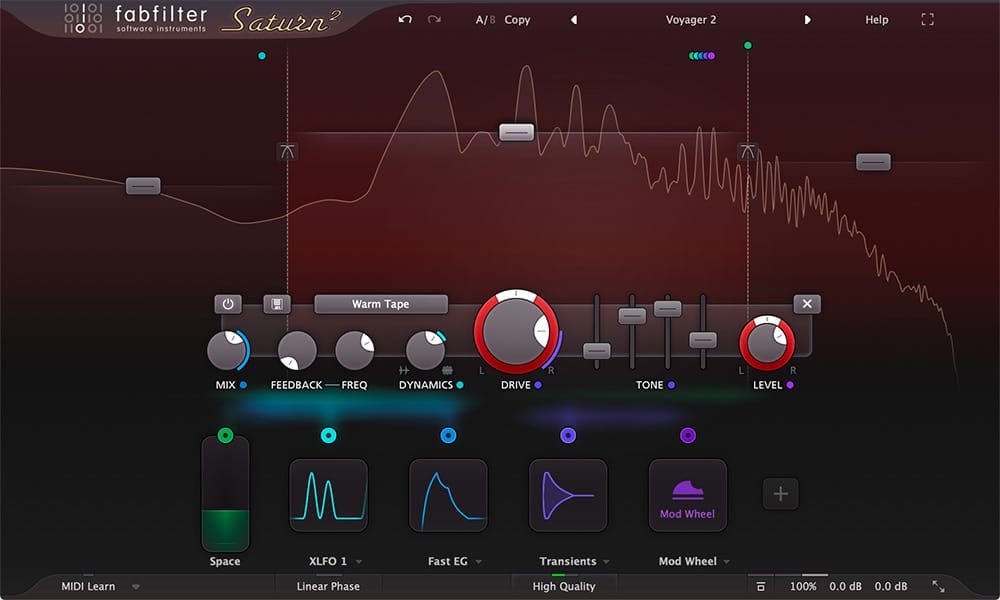
- FabFilter Saturn 2 — multiband, so you can fry the mids while keeping the sub clean. FabFilter literally quotes a producer saying he slaps it on 808s. Believe him.
3. Soft clipper at the end. The distortion you just added throws harsh peaks. A soft clipper shaves them off so you can push the level higher without your master bus clipping digitally. A dedicated clipper like Kazrog KClip 3 (or its free sibling, KClip Zero) does the job — set the soften control, watch the peaks flatten, gain back your headroom.
4. Sidechain compression. Duck the 808 under the kick so the kick's transient lands first, then the distorted tail rolls in. Even a one-knob sidechain does this. The kick should always win the race.
The cowbell
Less ceremony here. Pitch it to your key, then run it through the same saturation you used on the 808 — a touch of Decapitator does it. The trap isn't the tone, it's the harshness: cowbells live in the exact frequency range that makes ears bleed. Tame the top with a quick high cut and a dab of distortion to round the edge. Cutting, not stabbing.
Lo-fi textures and degradation
This is the step that separates "phonk" from "a trap beat with a cowbell." You want the sense that this thing has been chewed up by hardware that died in 2003.
- RC-20 Retro Color — the one everybody owns, for a reason. Vinyl crackle, tape wobble, bitcrush, noise — all in one box. Drop it on the drum bus, dial in the Magnetic and Noise modules, and back off until it sits.
- Baby Audio Super VHS — six one-knob effects built to sound like a worn-out VHS tape. The Drift knob alone is worth it for that seasick, slightly-out-of-tune wobble drift phonk lives on.
A word of warning: a little goes a long way. Degradation is seasoning, not the meal. Smother the whole mix and you get fog, not vibe.
The actual takeaway
Building a hard-hitting phonk track is organized chaos. Set these chains up once, save them in your default template, and stop rebuilding them every session — momentum matters more than perfection in this genre.
And the uncomfortable part nobody selling you a "phonk starter pack" will say out loud: none of these plugins will save a weak idea. The grit is the easy bit. A producer with stock plugins and good taste will smoke a producer with a $2,000 plugin folder and none. Buy the tools when they solve a problem you actually have — not because a YouTube thumbnail told you to.
Now go push something into the red. On purpose.